
Can You Build a House in Patna's Green Belt? Master Plan 2031 Rules
Short answer: what people in Patna call the "green belt" is the set of zones coloured green on the Patna Master Plan 2031 map, mainly the Urban Agriculture zone and the Conservation zone. In the Urban Agriculture zone you can build a house, but only under strict conditions: the land must not be leasehold, the building may cover no more than 20% of the plot, it may be at most 7 m tall, and at least 60% of the land must be under plantation or farming. In the Conservation zone plotted housing is prohibited; only dwellings for people who farm the land are allowed outright. The 100 m belt around village settlements is treated differently from both, and ordinary houses are allowed there.
Cheap plots on Patna's outskirts — towards Bihta, Naubatpur, Phulwari, Sampatchak, Punpun or Fatuha — are often sold without telling the buyer the land sits in the green belt. Buyers usually find out when the building plan is refused. This guide uses the master plan report and its Development Control Regulations (DCR) to explain what each green zone allows, how big a house a 2- or 5-kattha plot can actually take, and how to check the zone before you pay. For the plan as a whole, start with our pillar guide: Patna Master Plan 2031 explained.
What is the "green belt" in Patna — is it an actual master plan zone?
There is no zone called "Green Belt" in the Patna Master Plan 2031. DCR Regulation 27 lists the zones of the Patna Planning Area: residential, commercial, industrial, public/semi-public, open space, old city, urban centres, village settlements, urban agriculture, conservation, water bodies, special reservations and transport. The words "green belts" appear only as a permitted use inside the Open Space zone.
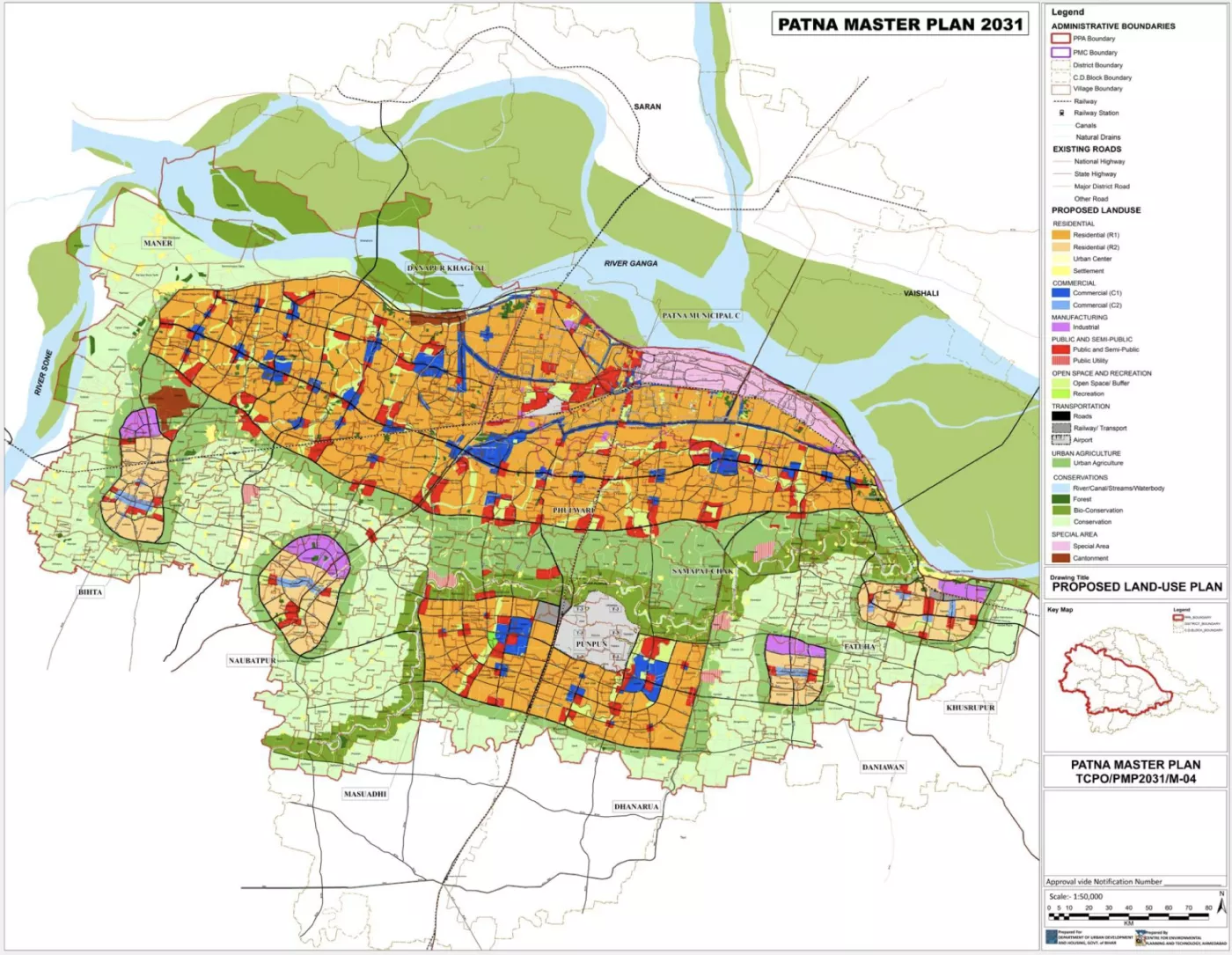
People say "green belt" because these zones are shaded green on the land-use map. The report itself groups them as "Green cover (Forest, Bio Conservation, Urban Agriculture)", about 525.97 sq km, of which the Urban Agriculture zone is about 134.06 sq km. The whole planning area is 1,167.04 sq km, and roughly half of it (49.89%) is not meant for urban development.
Which green zones are there in Patna, and where are they?
| Zone | Where | FAR | Can you build a house? |
|---|---|---|---|
| Urban Agriculture | The band around the contiguous core city and around the proposed townships at Bihta, Naubatpur and Fatuha (growth nodes) | 0.75 | Yes, with conditions: 20% coverage, 7 m height, 60% of land under plantation/farming, not leasehold |
| Conservation | Beyond the urban agriculture band — most of the remaining rural area | 0.50 | Plotted housing prohibited. Farm dwellings allowed. Other residential use only with the Authority's special approval, at 2% ground coverage |
| Bio-Conservation | Ganga lagoons and the land along the Punpun river | — | Not meant for housing; earmarked for riverfront and public recreation |
| Open Space Buffer | Along rivers, canals and water bodies | — | No; no construction within at least 9 m of a minor watercourse and 15 m of a major canal |
| Village settlement + 100 m belt (not green, but inside this area) | The village settlement and 100 m outside it | 1 | Yes, all types of residential buildings |
FAR (floor area ratio) is the total floor area allowed on all floors compared with the plot area. At FAR 0.75, a 1-kattha plot (about 1,361 sq ft) could carry about 1,021 sq ft in total. In the green belt, though, the real limit is the coverage and height rule, as the example below shows.
What are the conditions for a house in the Urban Agriculture zone?
Under DCR Regulation 28(4), residential and other buildings may be permitted in the Urban Agriculture zone only if all of these are met (along with the other regulations):
- The land is not leasehold.
- Ground coverage is not more than 20%.
- Building height is not more than 7 m.
- At least 60% of the land is used for plantation or agriculture.
The zone's row in DCR Table 4 lists "All types of Residential Buildings" as permitted, together with farming and horticulture, dairy and poultry, farm houses, dwellings for people engaged in farming, parks, playgrounds, and storage, processing and sale of farm produce. Schools, agro-processing, cold storage, godowns and "normal expansion of land uses only in the existing homestead land" need the Authority's special approval. Heavy industry, slaughter houses, wholesale mandis and storage of hazardous goods are prohibited.
Townships: Regulation 28(5) lets the Authority allow planned township projects in the Urban Agriculture zone, with the approval of the Bihar Urban Planning and Development Board. If a builder is selling a "township" in the green belt, ask for that approval. Buying farmland and cutting it into plots is not a planned township.
How big a house can you build on a 2- or 5-kattha green belt plot?
Figures use the Patna kattha of about 1,361 sq ft (check the area in your deed). A 7 m height limit usually means ground + one floor.
| Plot | Area | Ground floor (20%) | Ground + 1 floor | Plantation/farming (min 60%) |
|---|---|---|---|---|
| 1 kattha | ~1,361 sq ft | ~272 sq ft | ~544 sq ft | ~817 sq ft |
| 2 kattha | ~2,723 sq ft | ~544 sq ft | ~1,089 sq ft | ~1,634 sq ft |
| 5 kattha (~15.6 decimal) | ~6,806 sq ft | ~1,361 sq ft | ~2,722 sq ft | ~4,084 sq ft |
| 10 kattha | ~13,613 sq ft | ~2,722 sq ft | ~5,445 sq ft | ~8,168 sq ft |
What this means: a 1–2 kattha plot in the Urban Agriculture zone is not enough for a normal family home — a 1-kattha plot allows a ground floor of only about 272 sq ft, roughly one large room. The zone is designed for low-density, farmhouse-style homes on large plots. If someone is selling 1–2 kattha "green belt colony" plots and promising "three floors, no problem", that does not match the master plan rules.
Can you build a house on land in the Conservation zone?
The Conservation zone is the largest rural part of the Patna Planning Area, outside the urban agriculture band. Its rules are stricter (DCR Table 4, pages 274–275):
- Permitted: agriculture, horticulture, forestry; dwellings and ancillary buildings for people engaged in farming (rural settlement); existing residential uses and existing village settlements; agro-based cottage industries without power; milk chilling, foodgrain godowns, fertiliser and farm-produce storage; fuel stations; resorts, picnic and riverfront uses; village settlement expansion.
- Only with the Authority's special approval: apartment/corporate-type housing, higher educational and research institutes, hospitals, and residential use other than farm dwellings, subject to 2% ground coverage.
- Prohibited: plotted housing, small industries or small institutions, and any development between a river/canal/stream and its embankment.
To see how tight 2% is: even on 1 acre (about 32 kattha) the ground coverage is only about 871 sq ft; on 2 kattha it is about 54 sq ft. In practice, a small plot cut out of a Conservation-zone field has almost no legal route to a house.
What is the 100-metre village belt rule?
This is the most useful rule for anyone holding land in the green belt. Under the master plan (page 71), every village settlement outside the core area and growth nodes, as recorded in the revenue records (khasra maps), is in the Village Settlements zone. A further 100 m wide belt outside the settlement is also treated as part of that zone, to allow natural growth. FAR here is 1.
The report is explicit: even if this belt looks like Conservation zone on the map, it is not to be treated as Conservation zone. Inside villages, all types of residential buildings, clinics, schools, shops, places of worship and traditional household industries are permitted.
In practice: if your plot is next to a village settlement, check its distance from the settlement boundary on Bhu-Naksha. Being inside 100 m is a completely different position from a plot in the middle of the green belt. For a large deal, get the office that approves building plans to confirm in writing where the boundary is measured from.
What if a house already stands on green belt land?
Under DCR Regulations 27(2) and 28(9), any use that was lawful before the regulations came in may continue, but a use that does not conform to the zone cannot be extended or enlarged. The Conservation zone lists "existing residential or other uses" as permitted. In the Urban Agriculture zone, normal expansion within existing homestead land needs the Authority's special approval.
Note the word "lawful": a house built later without an approved plan does not become legal because of this rule.
Can green belt land be registered?
Yes. A master plan zone does not stop the sale of land; its rules apply to development and construction (DCR Regulation 27: development of any plot must conform to its zone). That is why green belt plots register without trouble, and why many buyers wrongly assume a house will follow. Registration and building plan approval are two separate things. How registration works: land registry process in Patna.
Exception: in the special area of the Patliputra Greenfield Satellite Township (273 villages in 9 blocks), the ban on sale and purchase was lifted on 1 August 2026, but development and construction remain banned until 30.03.2027, and a draft Development Plan 2047 is to replace PMP 2031 there. See Patliputra Township: registry open, construction banned and the 273-village list.
Land conversion has ended — does that make green belt land buildable?
No. Bihar's land conversion law was repealed in 2026, so you no longer need an SDO conversion before building on farmland. But inside the Patna Planning Area, the master plan zone decides whether a house is allowed, and the green belt rules are unchanged. The master plan (page 150) says no change of land use is permitted until zonal plans are made. Details: Bihar land conversion repealed: rules for building on farmland.
The state government may relax land-use criteria for government-sponsored projects (Regulation 28(8)); that relaxation does not cover private plots.
How do I check whether my land in Patna is in the green belt?
- Is the village in the Patna Planning Area? Take the block and mauza names from your khatiyan or jamabandi. The 13 blocks and 575 villages are covered in our master plan guide.
- Look at Map 21 in the report: the report is free on the PMAA website. Using the colours above, see whether your area is orange (residential) or green.
- Match it with the khesra map: download your plot's map from Bhu-Naksha; the distance to the village settlement shows there too.
- Get it in writing: for a plot near a zone boundary, or any large deal, ask the office that approves building plans (the municipal body or the Patna Metropolitan Area Authority) to confirm the zone in writing. A seller's or agent's word is not enough.
- Builder colony? Ask for the layout approval, the Regulation 28(5) approval if it is a township in the Urban Agriculture zone, and the RERA registration.
- Patna Master Plan 2031 report — Town and Country Planning Organisation, Urban Development & Housing Department, Bihar (in force from notification no. 831 dated 28.10.2016). Printed page numbers: land-use split, green cover 525.97 sq km, urban agriculture ~134.06 sq km — p. 66; Proposed Land Use map (Map 21) — p. 67; Village Settlements, Urban Agriculture and Conservation zones — p. 71; Bio-Conservation — p. 72; no change of land use until zonal plans — p. 150 — report PDF (pmaa.bihar.gov.in)
- Patna Master Plan 2031 Development Control Regulations (in the same report): Regulation 27 (zones) — p. 260; Table 4 — Village Settlements pp. 263–264, Open Space zone ("Green belts") p. 272, Open Space Buffer 9/15 m p. 273, Conservation zone pp. 274–275, Urban Agriculture zone pp. 276–278; Regulations 28(4), 28(5) — pp. 278–279; Regulations 28(8), 28(9) — p. 279
- Patliputra Township construction ban: notification 4655 dated 24.04.2026; sale/purchase ban lifted: notification 8024 dated 01.08.2026 (Urban Development & Housing Department)
- Bihar Gazette (Urban Development Department) checked up to 18.10.2026: the 2026 Bihar Building Byelaws amendment (Gazette no. 462, 07.05.2026) does not change these zone rules; the Bihar Building Byelaws 2026 are still a draft.
What should you do before buying a green belt plot? (Our advice)
- Zone first, price second. Green belt land is cheaper because little can be built on it. Don't pay residential-zone prices for it.
- "We'll get the plan passed" — ask for that in writing, with the rule it relies on. No agent can change the conditions above.
- Avoid small plots. 1–2 kattha in the Urban Agriculture zone won't take a usable house; plotted housing is prohibited in the Conservation zone.
- Measure the distance to the village. A plot within 100 m of the settlement may fall in the Village Settlements zone, where the rules are far easier.
- Check rivers and canals. Nothing may be built between a river or canal and its embankment, and there are 9 m and 15 m buffers from minor watercourses and major canals.
- Buying as an investment? There is no fixed route or date for a zone change. Nobody can promise what the zonal plans will do.
- Papers still matter. Even with the right zone, check the jamabandi, mutation and deed chain: Patna plot buying guide and how to avoid land fraud in Patna.
Patna green belt: frequently asked questions
- Can I build a house in Patna's green belt?
In the Urban Agriculture zone, yes, with conditions: not leasehold land, ground coverage up to 20%, height up to 7 m and at least 60% of the land under plantation or farming. In the Conservation zone plotted housing is prohibited; dwellings for people who farm the land are allowed.
- Will a building plan be approved on green belt land?
Only if the house fits the zone rules. In the Urban Agriculture zone, a plan beyond 20% coverage or 7 m height does not conform. In the Conservation zone, an ordinary plot is very unlikely to get a house approved because plotted housing is prohibited there.
- What is the FAR in the Urban Agriculture zone in Patna?
0.75. It is 0.50 in the Conservation zone and 1 in the Village Settlements zone. In the Urban Agriculture zone, though, the 20% coverage and 7 m height limits bind first.
- What is the 100 m rule near villages?
A 100 m belt outside each village settlement recorded in the revenue maps is treated as Village Settlements zone, even if the master plan map shows it as Conservation. FAR is 1 there, and all types of residential buildings are allowed.
- Can green belt land be registered?
Yes. The zone does not stop a sale; its rules apply to construction. So a registered deed is no proof that a house can be built. Exception: construction is banned until 30.03.2027 in the Patliputra Township special area.
- Can the green belt zone be changed?
The master plan says no change of land use is permitted until zonal development plans are made, and most zones do not have a notified zonal plan yet. Don't buy on the hope of a zone change.
- Now that land conversion is gone, is building in the green belt easier?
No. Revenue conversion has ended, but the master plan zone rules still apply in the Patna Planning Area. The zone and building plan approval decide whether a house can be built.
This article was written on 18 October 2026 from the official Patna Master Plan 2031 report and its Development Control Regulations, the Patliputra Township notifications (4655, 8024) and the Bihar Gazette (Urban Development Department). Kattha figures assume 1 kattha ≈ 1,361 sq ft; go by the area in your deed. The master plan map is small-scale; confirm the zone of a specific plot with the office that approves building plans. This is general information, not legal advice. Before a large deal, have your papers and zone checked by someone qualified.