

Khata vs Khesra vs Plot Number: Bihar Land Terms (Patna 2026)
Short answer: a khata is the account number of a landholder (raiyat) in the khatiyan; all of that person's land sits under it, much like a bank account number. A khesra is the survey number of each individual plot, unique within its revenue village (mauza). In Bihar's government records, "plot number" means the khesra number. The "Plot No. 14" on a Patna colony layout is a different thing: it is the seller's own number and does not exist in any government record. Registry and every online check run on mauza, khata and khesra.
A typical case: someone working in Bengaluru likes "Plot 14, 2 kattha" in a new colony near Danapur. The broker sends a colourful layout map. But the moment they try to check the jamabandi online, the portal asks for mauza, khata and khesra, and the colony plot number is of no use. This guide explains which number is which, where each one is written, and how kattha and dhur in Patna convert to the decimals used in government records.
What is a khata number?
The Revenue Department's glossary defines the khata as the number recorded in a person's name when the khatiyan was prepared during the survey, showing all of that person's land. The department itself compares it to a bank account number.
- One khata can hold several khesras: different fields of one raiyat under a single account.
- Per the glossary, when land passes to someone else by sale or succession, the same khata number goes with that land to the new owner. The khata is a survey-era number; a new one is not created at each sale.
- Who the land stands in the name of today is shown by the jamabandi, not the khata (explained below).
What is a khesra number?
The glossary defines khesra as the serial number of each plot in the survey, unique within a revenue village. On Bhu-Naksha, the number written inside each parcel of the village map is its khesra.
The key point: a khesra number is unique only inside its own mauza. "Khesra 100" exists in hundreds of villages across Patna district. Always quote a khesra together with the circle and mauza (with its thana number); a khesra number alone does not identify any land.
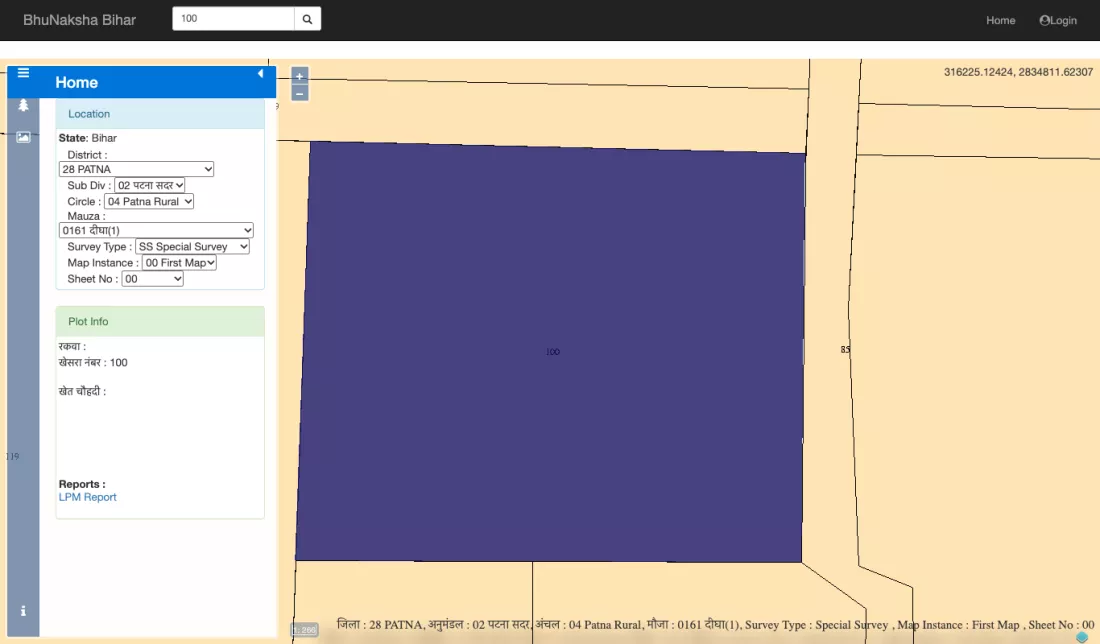
Is a plot number the same as a khesra number?
In Patna, "plot number" is used in two different senses, and that is where buyers get confused:
| Where "plot number" appears | What it actually is | Searchable in government records? |
|---|---|---|
| Khatiyan, jamabandi, Bhu-Naksha, official English papers ("Plot No.") | The khesra number. The Revenue Glossary gives "plot number" as the English meaning of khesra. | Yes |
| A colony or layout map, a broker's brochure, "Plot 14" | The seller's or developer's own number, given when a field was cut into plots | No. It is not in the khatiyan or jamabandi. |
On the edges of Patna (Danapur, Phulwari, Bihta, Naubatpur, Punpun, Sampatchak circles), one large khesra is often cut into many small plots. Your "Plot 14" is then part of a khesra. Match these three things on paper:
- Which khesra your plot lies in (sometimes it spans two).
- How much area of that khesra is being sold to you.
- The boundaries (chauhaddi) of your portion on all four sides.
The sale deed (kewala) can mention the colony plot number, but it must carry the mauza, thana number, khata, khesra, area and chauhaddi. Mutation is done on those.
Jamabandi number, thana number, bhag-prishth: the other numbers
| Number | What it is | Where you find it |
|---|---|---|
| Revenue thana number | The identification number of each revenue village (mauza). Bhu-Naksha shows it in brackets after the mauza name, e.g. "Digha(1)". It is the village's number, not a police station's. | Khatiyan, sale deed, Bhu-Naksha |
| Khata | The raiyat's survey-era account holding all their land | Khatiyan, jamabandi, sale deed, LPC |
| Khesra | The survey plot number, unique within the mauza | Khatiyan, jamabandi, sale deed, Bhu-Naksha |
| Jamabandi number | The current holder's account in Register-II (jamabandi register), against which land rent is paid. After mutation, a new jamabandi opens in the buyer's name. | Rent receipt, jamabandi register |
| Bhag-prishth | Volume (bhag) and page (prishth) of the jamabandi register | Rent receipt, jamabandi register |
| Rakba | Area of the land (mostly acres and decimals in government records) | Everywhere |
An easy way to remember it: khata and khesra are survey numbers (where the land is, which account it falls in). The jamabandi is the present-day number (whose name the land runs in, who pays rent). More on the register in checking jamabandi, khatiyan and LPC online.
One khesra, many owners: the most common mismatch in Patna
At survey time a khesra stood in one raiyat's name. In the decades since, partitions and sales have often split it among many people. So the seller's jamabandi may hold only part of the khesra (a share of its area), not the whole of it.
| Check | Where | Red flag |
|---|---|---|
| Is this khesra in the seller's jamabandi? | Bihar Bhumi → view jamabandi register | The khesra is not in the seller's jamabandi at all |
| How much area of it is left in the seller's name? | Jamabandi register | Area being sold is more than what remains in the jamabandi |
| Is someone else's mutation pending on the same khesra? | Bihar Bhumi → mutation application status | A recent application on that khesra is still pending |
| Where is the khesra on the ground, does it touch a road? | Bhu-Naksha (LPM report) | The plot shown on site does not match the khesra on the map |
| Land type of the khesra (e.g. gairmazarua) | Khatiyan | A land type that calls for extra caution in a private sale |
Step-by-step guides: mutation status, Bhu-Naksha and the LPM report, khatiyan download.
How to find the khata and khesra number of land in Patna
- From the seller's papers: the old sale deed, rent receipt, LPC or a khatiyan copy. The rent receipt carries the circle and the jamabandi number or bhag-prishth.
- By name, online: on biharbhumi.bihar.gov.in, open "view jamabandi register", choose district Patna, circle, halka and mauza, and search by the raiyat's name. The jamabandi lists the khata and khesra. No login needed.
- From the map: if you know where the land is, open the mauza map on bhunaksha.bihar.gov.in and click the parcel to see its khesra number.
- Khatiyan: bhuabhilekh.bihar.gov.in searches by khata, khesra or raiyat name.
Every record in one place, and which number each one needs: Bihar Land Records Online: complete guide. Which circle your land falls in: all 23 Patna circles.
Will the special survey change khata and khesra numbers?
Bihar's Special Survey is under way. It draws a fresh map of each plot as it stands today and prepares a new record of rights. So the khata and khesra numbers of the new survey need not match the old CS/RS numbers.
- On Bhu-Naksha, open both the old (CS/RS) and the SS (Special Survey) map of your mauza and see which number your land carries in each.
- The stage of the SS map shows under Map Instance. An early map such as "First Map" is not final; the final one is the "Final Published Map". Details in our Bhu-Naksha guide.
- If the new survey shows a wrong name, khesra or area, dlrs.bihar.gov.in → special survey services has claim and objection options. Objections have fixed time windows, so act early.
Kattha, dhur and decimal in Patna: how big is 1 kattha?
Government records (khatiyan, jamabandi, LPM) mostly give area in acres and decimals, while deals in Patna are struck in kattha and dhur. The Revenue Department's glossary notes that the kattha varies across Bihar and that in the Patna area 1 kattha equals 1361 sq ft. Per the same glossary: 1 dhur = 1/20 of a kattha, 20 dhurki (kala) = 1 dhur, a bigha is about 20 kattha, and 1 decimal = 1/100 acre (435.6 sq ft).
| Unit (Patna) | Dhur | Decimal | Sq ft (approx.) |
|---|---|---|---|
| 1 dhurki | 1/20 | 0.0078 | 3.4 |
| 1 dhur | 1 | 0.156 | 68 |
| 1 kattha | 20 | 3.125 | 1,361 |
| 2 kattha | 40 | 6.25 | 2,722 |
| 3 kattha | 60 | 9.375 | 4,084 |
| 4 kattha | 80 | 12.5 | 5,445 |
| 5 kattha | 100 | 15.625 | 6,806 |
| 1 bigha (20 kattha) | 400 | 62.5 | 27,225 |
| 1 acre (32 kattha) | 640 | 100 | 43,560 |
Decimal to kattha: decimals ÷ 3.125 = kattha; multiply the fraction by 20 to get dhur.
Example: the jamabandi shows 10 decimals → 10 ÷ 3.125 = 3.2 kattha → 0.2 × 20 = 4 dhur, i.e. 3 kattha 4 dhur (about 4,356 sq ft).
Kattha to decimal: kattha × 3.125. For example, 2 kattha 10 dhur = 2.5 kattha × 3.125 = 7.8125 decimals.
These figures take 1 kattha = 1/32 acre (1,361.25 sq ft), which matches the glossary's 1361 sq ft. Older local practice can differ in some villages of Patna district, so even when the deal is in kattha, have the deed state the area in decimals/acres too, and for a large purchase get the land measured by an amin.
- "Revenue Glossary" (Bihar Revenue Glossary), Revenue and Land Reforms Department, Bihar — definitions of khatiyan, jamabandi, Register-II, khata, khesra, revenue thana number, rakba (pages 1-4); "Units & Agrarian Terms" section: kattha (1361 sq ft in Patna), dhur, bigha, kala/dhurki, decimal, acre — PDF
- Bihar Bhumi — view jamabandi register (search by khata, khesra, raiyat name, jamabandi number), mutation application status — biharbhumi.bihar.gov.in
- Bhu-Naksha Bihar — mauza names with thana number, khesra in Plot Info, survey types (CS/RS/SS) and map stages — bhunaksha.bihar.gov.in
- Special survey online services — dlrs.bihar.gov.in/services.html
- Glossary PDF re-checked on 16.10.2026; portals checked on 15-16.10.2026.
What should you do? (our advice)
- Ask the broker for these first: circle, mauza (with thana number), khata, khesra and area. A colony plot number and a coloured layout are not enough to check anything.
- Before paying any token, check the jamabandi yourself: the khesra is in the seller's name and enough area is left. Don't rely on screenshots the seller sends.
- On site, carry the Bhu-Naksha LPM report and match the neighbouring khesras.
- Write the kattha figure in decimals too, so there is no "Patna kattha or village kattha" dispute later.
- Full checklist: plot buying guide for Patna. All our land-record guides: Land Records.
Khata and khesra: frequently asked questions
- What is the difference between khata and khesra?
A khata is a landholder's account number in the khatiyan, holding all their land, like a bank account number. A khesra is the survey number of an individual plot, unique within its mauza. One khata can contain several khesras.
- Is the khesra number the same as the plot number?
In government records (khatiyan, jamabandi, Bhu-Naksha), yes: "Plot No." means the khesra number. A plot number on a Patna colony layout is the developer's own number and does not appear in government records.
- How many sq ft is 1 kattha in Patna?
The Bihar Revenue Department's glossary puts 1 kattha at 1361 sq ft in the Patna area. That is 20 dhur, or about 3.125 decimals; 32 kattha make an acre.
- How do I convert decimal to kattha in Bihar?
For Patna, divide decimals by 3.125 to get kattha, then multiply the fraction by 20 for dhur. 10 decimals = 3.2 kattha = 3 kattha 4 dhur. 1 decimal = 6.4 dhur.
- How can I find the khata khesra number of my land in Bihar?
Look at the rent receipt, an old sale deed or LPC. Online, open "view jamabandi register" on biharbhumi.bihar.gov.in, select district, circle, halka and mauza, and search by the raiyat's name; the jamabandi shows khata and khesra.
- Does the khata number change after a sale?
Per the Revenue Glossary, no: the same khata number passes with the land to the new owner. After mutation, however, a new jamabandi opens in the buyer's name, and land rent is paid on that jamabandi from then on.
- What is the thana number in Bihar land records?
It is the revenue thana number, the identification number of a revenue village (mauza). It is the village's number, not a police station's. Bhu-Naksha shows it in brackets after the mauza name.
This article is based on the Revenue Glossary of the Revenue and Land Reforms Department, Bihar, and information on the Bihar Bhumi, Bhu-Abhilekh and Bhu-Naksha portals as of 16 October 2026. It is general information, not legal advice. Before any deal, confirm with the original papers, a government measurement and the circle office.


